Saturday, July 23, 2011

2011: ¿Vamos a leer?


Throughout the past few weeks, we have focused on identifying potential themes in the stories we read, generating summaries, and connecting with characters' feelings. The girls were more than enthusiastic to share their connections with the characters. As time went on, they also were eager to share their "resumens" of the books we read. I have seen a lot of improvement.

What proved to be difficult was having deep discussions around theme. The first few times we read together, there were few hands raised when I asked, "What do we think the author is trying to teach us? What is the broad idea or message in the story (aka theme)?" even after defining and discussing what theme is and means. Initially, those who did answer, came up with very general ideas. With time and questioning, using textual evidence and several simple examples, we learned how to draw conclusions about what each author may be trying to portray.

It was exciting for the Yahoskas to realize that there can be many correct answers to the questions I was asking. All one needs is reasonable evidence to prove a point, and with textual backup, almost anything can be argued. I loved watching the smiles on the girls faces when I validated their responses. Having watched students in Richmond, California light up when being complimented and validated, even for repeated responses already given, I knew this aid me in drawing more of the Yahoskas into discussions. The teaching profession easily transcends countries' borders :)

I also want to thank my college professors and mentors - they never gave up on me and believed I could be a successful Haverford student despite my rural, public school background. Any student has the ability to achieve a high-quality education, and Haverford gave me a chance! These students in Nicaragua deserve these chances as well.

Sunday, July 17, 2011

2011: Library Organization and Reading Workshops


Nour and I spent many hours reorganizing the previously purchased books into sections. Since we had no means in which to level the books according to grade level, we bunched the primary books on specific shelves and the secondary books on others, all with appropriate labels. The first go around, the books were categorized by genre, but this new system seems to be working better - the girls are learning to reference and visit the shelves that correspond more closely to their reading levels (see before and after photos above).

We taught them the rule of five, aka if there are more than five words that you do not know on one page, the book is probably too hard for you. It is time to put it back and find another book! Thanks to many of my great mentor teachers, this seems to be working.

After teaching the girls the rule of five, we modeled and practiced how to return books to the library. Starting with the smallest girls, we demonstrated just how nicely we can put our books back on the shelf (to the left is a photo of our participation line). Since this lesson, the library has been in much better shape every day we have returned.

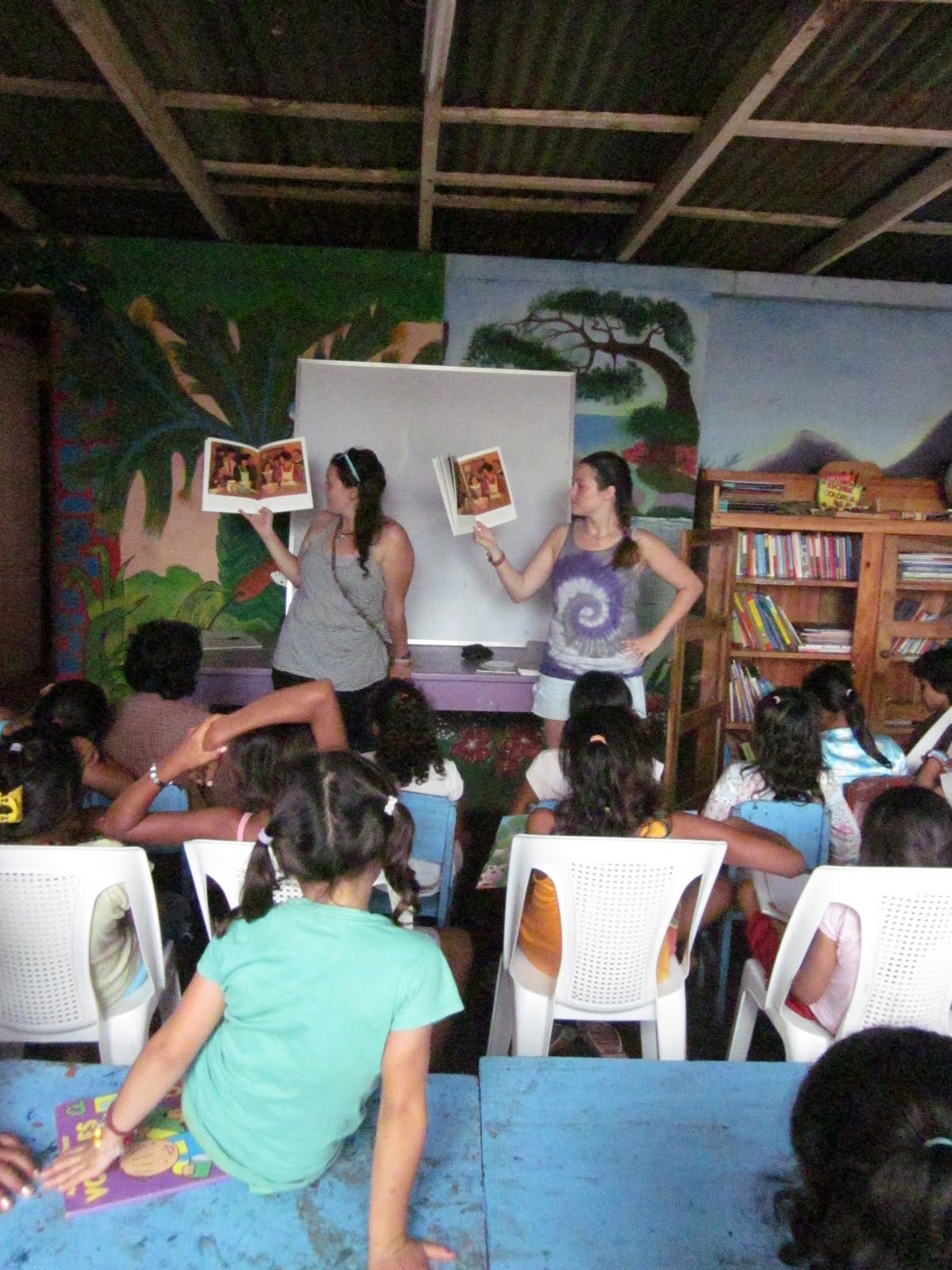
Since then, I have spent every day doing a series of reading workshops. I start by doing a read-a-loud that has a strong message or vivid imagery. While reading the book, we stop and make predictions, check for comprehension, make connections to our own lives, and summarize what we have read.

Throughout the passing weeks, I am pleased to see that the girls are extremely eager to participate in reading workshop. I walk into their home and one of the first questions they ask is, "Margarita vamos a leer?!" This daily question has kept me smiling through the parasites and recent kidney infection.

Wednesday, July 6, 2011

2011: The love of reading is learned


After having settled into a concrete pattern, I am starting to feel the forgotten tug at my heartstrings as I read more and more with Las Yahoskas. I returned to Nicaragua to see the library I started in a state of disarray. The books were disorganized, all the puzzles Nour, another Haverford volunteer, had purchased were left in pieces, and the posters I had made were in a corner. Despite this, it is clear that the girls have been using the books, which is a start.

Reading books is the first step, but easy access to books that a child can comprehend is the next step. The library needed to be reorganized, cleaned, and revamped. The girls need to be taught how to organize and maintain the library without volunteers doing it for them. Having learned many things from my Teach for America experience, I have come to realize I did a poor job of teaching library procedures to the girls. Building this notion into my volunteer plans, I now realize that I gave the girls fish without teaching them how to catch the fish themselves. Over the past week, Nour and I have spent many hours organizing, planning, cleaning, and teaching. The fishing practice has begun. Details to come!


2011: La Iglesia


I had my first Nicaraguan, Evangelical church experience last Tuesday. My homestay mom, Dona Ivania, asked me to accompany her, so I thought I would give it a shot. As we entered the open-air church, it started to downpour on the tin roof above, relaxing me. I continue to be comforted by the sound of the rain's pitter-patter. As the rain came down, the small congregation began to sing a sweet song saying, "Let god rain down on us." The song continued for about an hour, and as time went on, I watched many people sway to the music while weeping. The singing provided an outlet in which this amazing community could release their emotions. In places that bear such hardships, church remains a place in which people can come together and release pent up feelings.

Tuesday, June 28, 2011

2011: 4th Grade Philanthropy Project


My year has been full of laughter, tears, and amazement as a Teach for America Corps Member. Teaching 4th grade at the lowest performing elementary school in Richmond, California has been an incredible learning experience. My 32 students were full of energy, excitement, and passion. As the year progressed, I started to share my Nicaraguan experiences in the classroom. My students' interest was instantly sparked and they continuously asked me questions about the Yahoskas and Los Quinchos.

Feeding off their energy, I planned and implemented a philanthropy unit, in which the students read Three Cups of Tea: The Young Readers Addition as a class. The students developed a class philanthropy project, and chose to center their goal around the Yahoskas. The goal was to fill a suitcase with useful donations. Their project was a success! I am leaving for Nicaragua in the morning, loaded with a 48 pound suitcase full of Spanish books (donated by my students, their parents, several other donors, and some that I purchased) and a 47 pound suitcase full of other donations. I am extremely impressed by my students drive and generosity.

My students also wrote pen pal letters to the Yahoskas. While in Nicaragua, I will conduct a series of writing workshops in which I will help the Yahoskas learn how to write friendly letters in a three paragraph format. I think they will really enjoy connecting with my 4th graders, many of whom are from Mexico. In several of their letters, students describe their experiences as Latinos in the United States, as well as what life is like living in an impoverished, urban community.

Saturday, July 4, 2009

2009: Founding the La Yahoska Library

2009 Project Summary:

1) The Yahoska library was constructed, thanks to the many donors (you know who you are!). The girls now have access to books at their home. With the $2000 raised, I was able to buy several hundred books for the library.


To the right is Doña Ivania (the Los Quinchos librarian/my homestay mother) at Ispamer, the main book store in Managua. In the middle is a photo of Chris (a carpenter from the United States, was generous enough to make the bookshelf for free) and a few workers from Los Quinchos helping to set up the bookshelves needed for the project.

Below are photos of the girls helping to organize the books into categories, labeling of the categories on the bookshelf, and the final product!


2) Together, we did a good bit of both individual and group reading. I was pleased to see their interest and enthusiasm for reading increase over the course of my stay.


2) With the Yahoska psychologist present, we organized and lead a two-part sexual education workshop with the oldest girls. Each session lasted about two hours and the girls had the chance to discuss any topics they chose. For thirty minutes, the girls wrote down questions they had and passed them in anonymously. We then formed a circle and placed all the questions in the middle. The girls read them aloud and we had discussions about each question. The intention was to only do one session, but the girls requested a second.

3) Using the poetry of Ruben Dario, Garcia Lorca, and Pablo Neruda, I put together poetry

books for each of the girls. Using these compositions, we engaged in poetry workshops in which we learned about similes, metaphors, personification, and the use of vivid imagery. After the workshop series, the girls had the chance to write their own poetry and prose. The girls produced some fantastic work!


4) Using the poetry and prose the girls wrote over the duration of the workshop, they performed their favorite pieces at the Quinchos first Open Mic Night. Italian volunteers, the directors of Los Quinchos, as well as many boys from the boys program attended the two-hour performance. The girls performed beautifully. To prepare for the performance, we had a long dress-rehersal. We practiced how to project our voices, speak with distinction, and stand proudly to share.


Monday, June 22, 2009

2009: Return to Nica. Fundraising and Planning


I feel fiery and frenzied as I fiddle with whatever I can get my hands on...anxiously waiting to return to Nicaragua, the country I started to know and love summer of 2009. I am ready to return!

About a month from today I will be lucky enough to return to Nicaragua for a second CPGC internship, entitled as a "continuing connections" grant. I can't describe the pent up excitement that is causing me to wretch around in my desk chair every day while doing psychology research at Haverford College (for the two months preceding my internship). So the 2009 blog starts here! Please read below if you are interested in my last year's adventures.

Firstly, I would like to thank Jeffrey and Christina Lurie, who have been ever so generous as to contribute a generous donation to my upcoming library project. The plan is to start a library at the Yahoska complex (read below for a description). This week I will be sending out letters to friends and family in order to raise more money for books and library supplies. Library project #2 is getting way.

I also met a psychologist during the Red Sox/Phillies game who is eager to help me plan my second project for the summer, a small poetry/writing workshop. The workshop will try to incorporate and encourage the expression of pain and domestic violence topics. This psychologist has written a book for adults regarding the process of surviving 'rape and sexual assault,' and he is also on the review board for a known psychology journal.

The race is on to plan as much as possible in the next month before I head down south. But as many of us know, plans need to be malleable if any implementation and sustainability is desired.

Friday, August 29, 2008

NOTE TO READERS

A few people have been confused -- the entries at the top are the most recent.

Sorry if my grammar isn't perfect. I haven't had time to edit my spit fire entries I compose at the internet cafes (sivers).

Wednesday, August 27, 2008

2008: Reading Celebration


El Concurso de Lectura was a success in the Yahoska household! The winners of the contest read tons of books in a three week period. It was such a fun experience to walk into town with the girls for Ice Cream (first with the younger winner and then with the older winners a second time around). We followed our ice cream shop visit with a visit to the park to play. I forgot how excited kids get before and after they go out for ice cream :)


Wednesday, July 30, 2008

2008: Somos Bonitas Adentro y Afuera (We are beautiful inside and out)

Many of the Yahoska girls have never been asked to discuss their inner feelings about their personalities, but project Somos Bonitas Adentro y Afuera prompted some of these sentiments.

Two weeks ago I took individual photos of each girl and had them printed in Managua. It was an incredible process to find the hard-backed poster board I wanted to mount the photos on. I took a bus to a neighboring town to find a large styrofoam piece from an appliances store. I painted the board red and pasted the photos of the girls in order of youngest to oldest. Below every photo I wrote ADENTRO: and AFUERA:. I brought the poster board to the home of the Yahoskas, and was immediately surrounded by smiling faces and screeching voices saying, "ENSEÑA!". After every girl got a good look at the poster, we began the two day process of discussions.

We talked about what we thought was beautiful (both inside and out) about the personalities and faces of each girl. We talked about how the media often emphasizes outer appearances, and how it is important to realize there is more to a person than the clothes they wear or makeup they put on. A few of the girls blushed and smiled nervously as we talked, but eventually they all warmed up and enjoyed talking about their favorite personality traits and physical features.

Sunday, July 20, 2008

2008: The Reading Contest - El concurso de Lectura


Reading is an activity that is inaccessible to many in Nicaragua. With the 300+ books that have been added to the Quinchos library, thanks to my generous donors, Los Quinchos have bright new books to read. 

To motivate students in Los Quinchos to read, organized a small competition between the girls and boys of Los Quinchos. We tracked the completion of each book with a sticker. Before a sticker was placed on the tracker, the students had to give a small summary, describe the theme, describe their favorite character, state what they learned, and answer a few comprehension questions. The two boys and two girls who read the most by the end of our internships (Gloria, Rose, and myself) were to receive a trip into town for ice cream!

I was a bit worried for the first week of the contest, because the kids were so busy and didn’t have time to come to the library, but two days ago I asked their caretakers if I could bring them to the library for extra reading time. This was no problem, and there started the beginning of the contest. All the students needed was a bit of encouragement and a person to walk them to the library. We will see who wins the contest☺

Below are photos of several Italian volunteers reading with the girls. A great portion of the funding for the Quinchos program comes from Italian donors, who often venture to Nicaragua to see the progress of the projects and to volunteer however they can.

Wednesday, July 16, 2008

2008: Puppy Rescue


All of the excitement of the paseo came on day three when we all took a trip to a beach about an hour away from the town. Right as the bus passed the various houses made of garbage bags and plastic which lined the beach, I noticed four tiny puppies in the sand. They were all struggling to stand up and seemed to be choking on the granules of sand. A few of the girls laughed, but most of them were concerned. I was mortified...

Gloria and I immediately got off the bus and picked them up. I filled my two Frisbees with water and put the overheated puppies into them so as to cool off. We scooped water into their mouths as they tried to stand up but could only then collapse back into the Frisbees. This situation was just too much for me to let go. There are hundreds of dogs I’ve passed by in Nicaragua, unable to do anything because they were ferule or grown up, but these puppies were vulnerable and were going to die if we did nothing.

Many people in my group thought I was crazy, but I took the puppies onto the bus while everyone else was at the beach, and poured water into their tiny mouths with the cap from my advil bottle. I looked ridiculous covered in sand, sitting on the floor of the old, dingy bus with a Frisbee on my lap and a dog in my arms. I called my mom to ask her what mixture of liquids I could give the dogs besides water, and she called our veterinarian to get a solid answer. She called me back and instructed me to mix milk, water, and eggs together. Cows milk is isn’t good for the puppies to drink straight, so the water would dilute it. The eggs were for extra calories, because the puppies were so starved.

The caretaker of the school (a young man who had grown up on the streets of Managua and went through the Quinchos program) traveled with us to the beach that day. He was one of the few people who followed me onto the bus, and he seemed interested in what I was going to do. I asked him if he would be willing to walk to the local town to buy milk and eggs to mix with the water. He gladly agreed and off he went with the sum on money I gave him. He promptly returned not twenty minutes later and handed me the items I’d asked for, along with two syringes. I had no idea the small desolate town would have syringes, and I was overcome with hope! What a thoughtful guy! My job was about to become much easier.

Using the syringe, I gave them all 4 ccs of the mixture and proceeded to let them rest. I ruffled the puppies fur with my sarong and then wrapped them all in it, placing them at the back of the bus to sleep. They were exhausted, but glad to be in a warm, comfortable place. They instantly crawled on top of each other amongst the comfort of my sarong, and were happily asleep.

For the next four hours, while the girls played and enjoyed the beach, I sat on the bus with the dogs, taking them to the bathroom (disgusted by the parasites I could see in their fecal matter), feeding them, and ruffling their fur as to make them feel they had a mother to love them. I was really worried about two of them, as they couldn’t stand up on their own for most of the day. As time went on they quickly gained their strength back. A few of the girls stayed on the bus with me for most of the day, very interested in the process of rehabilitating dying dogs. We had some great conversations about animal care and the treatment of animals in Nicaragua.

I ended up taking the puppies back with me to the schoolhouse. I knew I would have a tough trip back to San Marcos the next day, as I was planning to leave a day early so as to get the dogs to the Veterinarian. The night was full of surprises. I put the puppies in a box with my sarong, and was frustrated but relieved when they gained enough energy to climb out of it. They began to develop some personality, and followed a few of the girls around when I woke them up to go to the bathroom. This was the point where I was starting to be sure I was doing the right thing. It was a bit of trouble to get them back to the schoolhouse, and I hadn’t played with the girls on the beach. I knew it had been beneficial for the girls who had stayed on the bus with me, so I hadn’t completely neglected my internship responsibilities.

That night, the same young man who had gone to retrieve the syringes, brought with him a friend, named Wilbur, who said he wanted one of the three puppies. I was hesitant at first, knowing the puppies were all very sick and needed massive amounts of attention. He told me he had wanted a dog for a long time and would take great care of it, giving it real puppy food. I made sure to ask him never to hit his dog, as I see many people do in Nicaragua. Wilbur responded with, “Claro que no!” Of course not! “I think it is awful how many of my fellow Nicaraguans treat animals, and I will never do that.” With this statement I was convinced, and I handed over one of the girls. The boy immediately wrapped the tiny thing in his shirt and said, “I will name her Princessa.” My smile spread ear to ear. By this time it was around eight thirty, so we spent the evening talking and making jokes, while I played with and comforted the other two tiny beings in the box. I showed Wilber how to feed Princessa with one of the syringes, which I gladly gave him as an accompanying tool for his new puppy.

After the boys left, I dragged my sleeping back outside. Rose, another volunteer, is allergic to dogs, so I decided it would be best to sleep outside with the puppies. Until sunrise, I woke up every hour and a half to feed the babies and take them to the bathroom. The night was full of whimpers from the dogs, screeching from the bats, and buzzing from the bugs. I was sure to thoroughly spray the perimeters around my mat with deet bug spray, for the insects here are far superior size wise to those in North America.

Gloria and I traveled back to San Marcos the next day. It may have been one of the most tiresome days of my life. We took a taxi to the town of Posletega, and then three buses to get ourselves to San Marcos. I played the role of “crazy gringa,” who thinks she the mother of a few puppies, for the span of the day. I did receive quite a few smiles alongside the weird looks. The most attention was paid when I whipped the puppies out on the concrete in the middle of the chaotic bus stations to go to the bathroom. People surrounded me on several occasions, all which asked where I got the dogs. My only response was, “they were abandoned by some mean person on a beach in the North. They were going to die if I didn’t take them with me.”

The microbus driver to my town asked me what happened, for I was sitting in the front seat with the anxious puppies. He seemed touched by the story and drove me to the Vets before he stopped at the normal loading place in the town square. The people here can be so nice!

I begged the vet to take the dogs for a few days, so as to rehabilitate them. He was nervous they wouldn’t make it because they had some blood in their fecal matter and urine. Thanks to the emergency fifty dollar bill my grandmother gave me five years ago, that I have kept in my wallet since, I was able to pay for all of their medicine and their five day stay with the vet. Might I mention that vets here don’t normally take animals overnight, but my fifty dollar bill convinced the nice man. He only charged me five dollars a day to take them….not bad compared to what that would be in the states.

I found a home for them the same day. A friend of my family was looking for a puppy, and agreed to take them both. Yay!! I then slept for 22 hours straight, only waking up to have dinner shoved down my throat and to go the bathroom. Gracias adios!!

2008: Paseo con Los Quinchos


It is hard to truly view all of the tradegy and extreme problems of Nicaragua, and I came to this realization when I accompanied 15 of the Yahoska girls on vacation to a northern town called Posletega. For two weeks the girls school had vacation, and about half of the girls went home to their families to visit. The interesting part of the trip started with a bumpy ride to the North of Managua, which eventually caused the old, rickety bus to break down. The Yahoska workers played this off well and pretended it was merely a stop for lunch. After the bus cooled down, we chugged on to our destination.

The Quincho program doesn’t have exuberant amounts of money, so they travel to places where they can sleep for free. About eight years ago a volcano erupted and killed thousands of people in and around the town of Posletega. The Quinchos reached out to the devastated place and built a school about three kilometers from the main town. This was where we stayed.

The first day was full of Frisbee, soccer, a piñata, and story telling. Before bed I read the girls a meditation from a book I was so lucky to find on our latest trip to Managua. It was so exciting because this book was one that was read to me when I was little, so it was crazy to be able to find it in Spanish (it was found in the used books section). Despite the older girls listening to their Reggeton music not a 100 meters away, the younger girls enjoyed the story and were intent to have it read to them every night they were on vacation.

We all slept in the two roomed school, the girls and their teachers in one room and the volunteers in the other. The rooms were divided by what seemed like a cardboard, wood collection. We slept on the Nicaraugan version of sleeping bags, which were merely cotton filled mats for the floor. Right as I was about to fall asleep the bats came to life and began to swoop in and around our room from the storage room to our left. Between the girls talking in their sleep in the next room and the “murciélagos” yapping, I slept very little the first and second nights.